Ineligible Man Downfield


You cant see either official in the broadcast of the game. Scates is moving forward as he points to the official. The official isnt going to say on or off. He will put his foot on the LOS and point to his foot indicating where the line of scrimmage is. Its then up to the WR to figure out where to be. The line judge will also "punch back" the WR if he is off the line, but that is to communicate with the official across the field.

Finally seeing the play again, maybe he thought Soehner (top of screen tight end) was off the line? I didn't catch it in real time, but Soehner is a little in no man's land.
 
I continue to be amazed how often college teams go with 8 on the line. In the OU game it was clearly by design when they called the penalty on Kolar (88) by mistake. Soehner (89) clearly was covered up, knew he was covered up, and the play was for him to stay at the LOS and block, which he did. But the refs confused 88 and 89.

Is there a reason we do this?
I would think the advantages would be offset by eliminating an eligible receiver. Even if he’s blocking, I’d think it would be better to keep him as an eligible receiver and make the defense account for him.
 
Soehner IS off the line. Allen is ON the line and thats who Scates covered up. There are only 3 men in the backfield, so clearly, Scates should have been off the line as well.
Do you mean Kolar in motion? I'm talking about the down tight end at the top of the formation. Soehner, Kolar, Hall and Purdy would make four.
 
I'm sure this is a stupid question, but can anyone tell me why this is even a rule? I have never understood the 'covered up by a WR' call. Seems to me you have 5 OL who are ineligible and everyone else is eligible. Why make it more complicated?
 
  • Like
Reactions: Clonefan32
I'm sure this is a stupid question, but can anyone tell me why this is even a rule? I have never understood the 'covered up by a WR' call. Seems to me you have 5 OL who are ineligible and everyone else is eligible. Why make it more complicated?
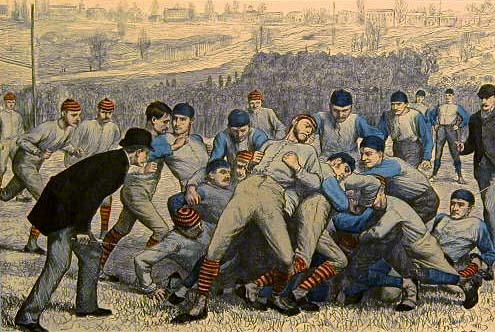
I believe it was to rid the game of the flying wedge, which was resulting in too many injuries.
 
Shaw got called for a procedure penalty Saturday, I think it was the TT game, as he tried to back away from the line. Is that because he waited until the TE was already set?
 
Whether it is, or should be, easy to comprehend or not-- I can't figure out why a step forward or backwards matters. It's a dumb rule.
 
Whether it is, or should be, easy to comprehend or not-- I can't figure out why a step forward or backwards matters. It's a dumb rule.
The whole idea is to make it clear and fair to a defense who they have to account for in coverage and who they don't. You can split out a couple of linemen if you want to and as long as they are on the line and not the last man on the line they remain ineligible so you don't have to account for them in coverage. Football would be a very difficult game to defend if all 11 players were eligible receivers.
 
Shaw got called for a procedure penalty Saturday, I think it was the TT game, as he tried to back away from the line. Is that because he waited until the TE was already set?

I recall watching that over a few times, I never saw anything wrong. My only guess is that the ref for some reason thought Shaw moved forward first before he moved back? But I don't see it.

Let's face it, refs too often call what they think happens, not what they actually see happen. The best example I can think of is Montgomery's "fumble" at the goal line in the Liberty Bowl. The refs who made the decision to call it a fumble were in no position to actually see when it came loose in real time. Yet they huddled, one of them probably said something like, "I'm pretty sure it came loose before the goal line." And of course replay was not definitive enough to overturn. Well, that's actually subjective also. I think there was, but it all depends on who your replay guy is. So, they made their best guess on the field as opposed to being honest and saying, "I didn't see it clearly to know when it came loose."

To me, for all games, an official should call what he actually sees, not speculate or guess. If you didn't see a ball come loose before the goal line, then don't call it. Don't call a fumble, or an interception, or a penalty, or a touchdown, or an out-of-bounds unless you actually saw it. Now, if it's a bang-bang play and you actually saw it (like a knee goes down just as a guy fumbles), that is hard to judge in real time and so you do have to go with what you believe. But when you don't actually see all the details of what happened, don't just make up a call, because that is what we see too often all over college football, IMO.
 
Shaw got called for a procedure penalty Saturday, I think it was the TT game, as he tried to back away from the line. Is that because he waited until the TE was already set?
Is that the one where he twitched and then tried to cover it up by going in motion? If you twitch, then momentarily pause and then go in motion they are going to flag you for it. If you just start your motion smoothly you generally aren't going to get flagged.

If that isn't the play I apologize. I would like to see it if someone has a link or can say when in the game it happened.
 
Is that the one where he twitched and then tried to cover it up by going in motion? If you twitch, then momentarily pause and then go in motion they are going to flag you for it. If you just start your motion smoothly you generally aren't going to get flagged.

If that isn't the play I apologize. I would like to see it if someone has a link or can say when in the game it happened.
This is probably the one you're talking about, obviously a false start. 41:35

 
  • Informative
Reactions: BigD
I'm sure this is a stupid question, but can anyone tell me why this is even a rule? I have never understood the 'covered up by a WR' call. Seems to me you have 5 OL who are ineligible and everyone else is eligible. Why make it more complicated?
Based on harimad's response:

The problem [with mass plays and particularly the flying wedge] wasn’t too many injuries. It was too many fatalities. A series of rules revisions were designed to abolish mass plays. It wasn’t easy to come up with rules that allowed for desired plays while not allowing mass plays. Consider when you are watching the game and a team is penalized for illegal formation. The formation rule seems like arbitrary nitpicking, but it was integral to eliminating the mass play. I noted earlier how Stagg moved the ends back two yards. They was key to setting up a wedge. This is why the offense has to have seven men on the line of scrimmage. This also is why there are restrictions on what motion is allowed in the backfield. Then there is the forward pass, which was instituted more or less as compensation for removing the mass plays from the offensive repertoire. Now the fatality rate has been brought within acceptable limits.​

 
  • Informative
Reactions: SEIOWA CLONE
Yeah, that is the one. What play was being referenced? This one or another?
You have the right one, I thought hjs movement was to get back off the line after the tight end moved. My mistake.

But it leads to my question, if the tight ends come in motion, then sets. and then the end moves back off the line, won't the wide out be called for procedure? Doesn't he have to move off the line while tight end is moving towards him?
 
You have the right one, I thought hjs movement was to get back off the line after the tight end moved. My mistake.

But it leads to my question, if the tight ends come in motion, then sets. and then the end moves back off the line, won't the wide out be called for procedure? Doesn't he have to move off the line while tight end is moving towards him?
It really matter less where you start as long as you have 7 on the LOS at the snap of the ball. You see teams shifting 2 TE's from one side of the line to the other, but they have to be behind the LOS. Moving forward to count as one of the seven on the line would be illegal.

The play that we are talking about was illegal, the TE was not far enough off the line to be considered to be off the line. You sometimes see tackles called for not being on the line during 3rd and longs. They fan back to try and get a step and a better angle on the rusher, but by moving back he is not on the line. Generally the ref is looking to see if the head of the tackle is through the hip of guard or further up. If his helmet is behind the hips of the guard, he is ruled not to be on the LOS.


You cant see either official in the broadcast of the game. Scates is moving forward as he points to the official. The official isnt going to say on or off. He will put his foot on the LOS and point to his foot indicating where the line of scrimmage is. Its then up to the WR to figure out where to be. The line judge will also "punch back" the WR if he is off the line, but that is to communicate with the official across the field.


I wonder what Kolar says to Purdy right before the snap.
 

Help Support Us

Become a patron