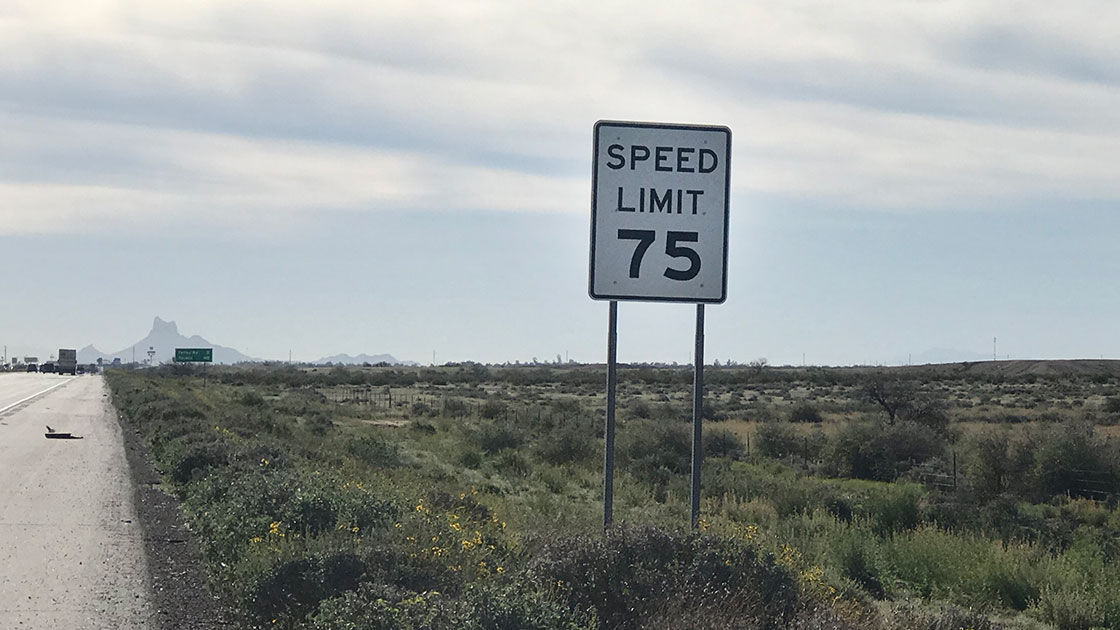
Raising Speed Limits Cost Lives

A 1997 Federal Highway Administration (FHWA) study found that raising or lowering speed limits by as much as 15 mph had very little effect on actual travel speeds. In many cases, raising a limit simply legalized the existing behavior of the majority without significantly increasing the top speeds.

Not sure if there has been a more recent study on this.

I’ll take my anecdotal evidence over this study. Whenever driving habits are discussed, people tend to report their speed relative to the speed limit. The idea of 7 or 9 mph over the limit keeps you from getting pulled over because of some rhyme has taken over in people’s minds. If the limit increases, so so the speed for most people I’ve talked to.

Now, there is certainly a limit to the point that people feel comfortable at a speed and may not go above that. So maybe raising it 15 mph hits that threshold. But I guarantee that people will get used to the higher speed eventually and then exceed it.
 
Yes, for .01% of the time. People are not just going to start running into each other for the 3 miles a year they have to drive.

Also, I've noticed that if it's rain that is stopping the cameras from working, you should probably pull over because if the camera can't see, neither can you.

Surely it’ll snow more than one day every 27 years?
 
Not much for the government to do on these though.
  • Limits on the amount of added sugar that can be put in food.
  • Tax sugar and alcohol like its tobacco.
  • Put pictures of ugly fat drunk people on the labels.
  • Spend money on advertising to scare people off booze and sugar.

The above has worked to reduce cigarette/tobacco use.

Not advocating for it, just saying there ARE things that can be done. Some are being done in some places.
 
  • Optimistic
Reactions: BACyclone
I thought I'd go to AI and see if any other states have made similar changes, and the results:

Minnesota (2019)

Minnesota is the most prominent recent example. In 2019, MnDOT increased the speed limit from 55 to 60 mph on over 5,200 miles of two-lane state highways after a five-year study.

  • The Results: A follow-up study found that the "mean speed" (the average speed of all drivers) only increased by about 1 mph.
  • The "Uniformity" Benefit: Engineers found that speed variance—the difference in speed between the fastest and slowest drivers—actually decreased. When the limit was 55, many people drove 60 anyway, while others stuck strictly to 55. Moving the limit to 60 got everyone moving at a more similar pace, which MnDOT noted can actually reduce "frustration passing" and rear-end collisions.
  • Safety Impact: While the 1 mph increase in average speed is technically a slight increase in risk, the state did not see a dramatic surge in rural road fatalities specifically attributed to this change.


  • Wisconsin (2015)

    Wisconsin went through a similar process, primarily focusing on its 65 mph highways moving to 70 mph, but it also evaluated its 55 mph rural trunks.
    • The Logic: Wisconsin authorities argued that "under-posting" a speed limit (keeping it at 55 when the road feels safe at 60) creates a higher number of speed limit violators, which makes it harder for police to identify truly dangerous drivers.
    • The Results: Similar to Minnesota, the actual travel speeds didn't jump by 5 mph; they typically nudged up by 1–2 mph because most drivers were already traveling near 60 mph.

 
Surely it’ll snow more than one day every 27 years?
I don't know where you get 27 years, but the cameras don't just stop when it snows. Certain conditions can make the cameras get clogged, but they try to build them so they don't. Each car is different too. My Kia seems to get clogged a lot.
 
  • The "Speed Variance" Factor: The study reinforced a key part of your 1997 premise: that speed variance (the difference between the fastest and slowest cars) is a bigger predictor of crashes than the absolute speed. They found that raising limits sometimes decreased variance by bringing the "slow" drivers up to the speed of the "fast" majority, which can actually improve safety in some contexts.
I recalled this and was going to mention.

Anecdote: downtown CR on the I-380 s-curve. When they put in the speed cameras on both ends, accidents went down a lot, because suddenly everyone was between 55 and 65mph. You didn't have some people at 55 and others blasting thru going 80mph. But that is also a place where there are multiple busy on/off ramps in a short space and a lot of traffic and two sharp curves. So you always had slow vehicles - braking to get off, speeding up to get on. Enforcing a lower limit there was a win.
 
I recalled this and was going to mention.

Anecdote: downtown CR on the I-380 s-curve. When they put in the speed cameras on both ends, accidents went down a lot, because suddenly everyone was between 55 and 65mph. You didn't have some people at 55 and others blasting thru going 80mph. But that is also a place where there are multiple busy on/off ramps in a short space and a lot of traffic and two sharp curves. So you always had slow vehicles - braking to get off, speeding up to get on. Enforcing a lower limit there was a win.
I think this was one of the few speed cameras that the Iowa DOT actually thought was a good solution. As opposed to the camera on 235 that didn't have an accident problem before or after the cameras were installed.
 
  • Like
Reactions: ISUJason
  • Limits on the amount of added sugar that can be put in food.
  • Tax sugar and alcohol like its tobacco.
  • Put pictures of ugly fat drunk people on the labels.
  • Spend money on advertising to scare people off booze and sugar.

The above has worked to reduce cigarette/tobacco use.

Not advocating for it, just saying there ARE things that can be done. Some are being done in some places.
I don't think our state government is exercising malfeasance regarding sugar and alcohol. Those are individual choices. Other states aren't really doing much different.

I shop in Minnesota and Wisconsin regularly and don't notice any different. Granted both of those states have high alcohol consumption rates.

Tobacco use has reduced due to anti-tobacco advertising campaigns, and general increase in health awareness. Unlike alcohol, tobacco doesn't really have a social positive effect that counterweights its health risks. People only ever used tobacco because they initially liked the feeling of nicotine and then were quickly addicted. Alcohol use is more complex and ingrained in thousands of years of human development.
 
  • Like
Reactions: Letterkenny
less risky passing from people going too slow clogging traffic lanes causing too many drivers to have to make decisions. There will always be poor drivers causing accidents, but slow drivers force too many people to have to pass -raising it 5 MPH don't know if it alleviates anything or the slow drivers are going to continue to force poor decisions or if the speeders will slow their roll a little. We'll see!
Stop ******* driving in the left lane on the interstate. Use it to pass that’s it. Stop driving glued to the rearview. Stop blocking traffic. These are the dumbasses that escalate tempers and cause aggressive driving.
 
I don't know where you get 27 years, but the cameras don't just stop when it snows. Certain conditions can make the cameras get clogged, but they try to build them so they don't. Each car is different too. My Kia seems to get clogged a lot.

0.01% equates to 1/10000. 10,000 days equates to 27 years.

But at this point I’m just being stubborn. By the time self driving cars become mainstream we probably have the technology to not leave the house for a day or two.
 
  • Limits on the amount of added sugar that can be put in food.
  • Tax sugar and alcohol like its tobacco.
  • Put pictures of ugly fat drunk people on the labels.
  • Spend money on advertising to scare people off booze and sugar.

The above has worked to reduce cigarette/tobacco use.

Not advocating for it, just saying there ARE things that can be done. Some are being done in some places.
So on the alcohol, it be pictures of an ugly person that says when you find them attractive this time to stop drinking?
 
  • Funny
Reactions: CascadeClone
On a side note, I noticed that Iowa is about ready to allow front side windows go from 70% tint to 50% tint. The world will probably end when Iowa goes to 50%, which is still one of the 10 most restrictive in the country.
 
0.01% equates to 1/10000. 10,000 days equates to 27 years.

But at this point I’m just being stubborn. By the time self driving cars become mainstream we probably have the technology to not leave the house for a day or two.
0.01% is also 1.2 miles if you drive 12k miles a year, but I can see you get my point.
 
The problem is that the forces that occur on vehicles and people during a crash do not involve simple math.
The equation to find kinetic energy uses the square of velocity, and humans don’t have a good intuitive ability to comprehend those differences at a glance.
We see 55 increasing to 60 and think that it’s not even 1/10 of an increase, so it must be marginal.
Punch in the values for a pair of 4,000 pound vehicles in a head-on collision at 110 and 120 mph, and you’ll see the difference is well over 500,000 additional pounds of force.
So not even a 10% increase?
 

Not to mention the increase in fuel costs.
Not this BS again. This is the same BS they used as justification to lower the speed limit to 55 all over the country, even on the interstate. It was originally touted as an energy saving measure because of the 1973 oil crisis, but they later justified it as also saving lives. Thankfully, they repealed that Nixon era law and speed limits are now the sole jurisdiction of the states.
 
  • Like
Reactions: VeloClone
Speaking of driving, we ran down to Costco yesterday and it looks like they are planing on shifting the northbound lanes of I-35 next week sometime to start construction on that side of the interstate. Lanes and barriers are up on the South bound lanes for the shift to occur and they were putting up green plastic items on the barriers, I suppose to keep the car lights better in than lane and be less distracting.

Does anyone know how far up they are going with the 3rd lane? Just to the south edge of Ames and highway 30 or all the way up through Ames?
 

Latest posts

Help Support Us

Become a patron