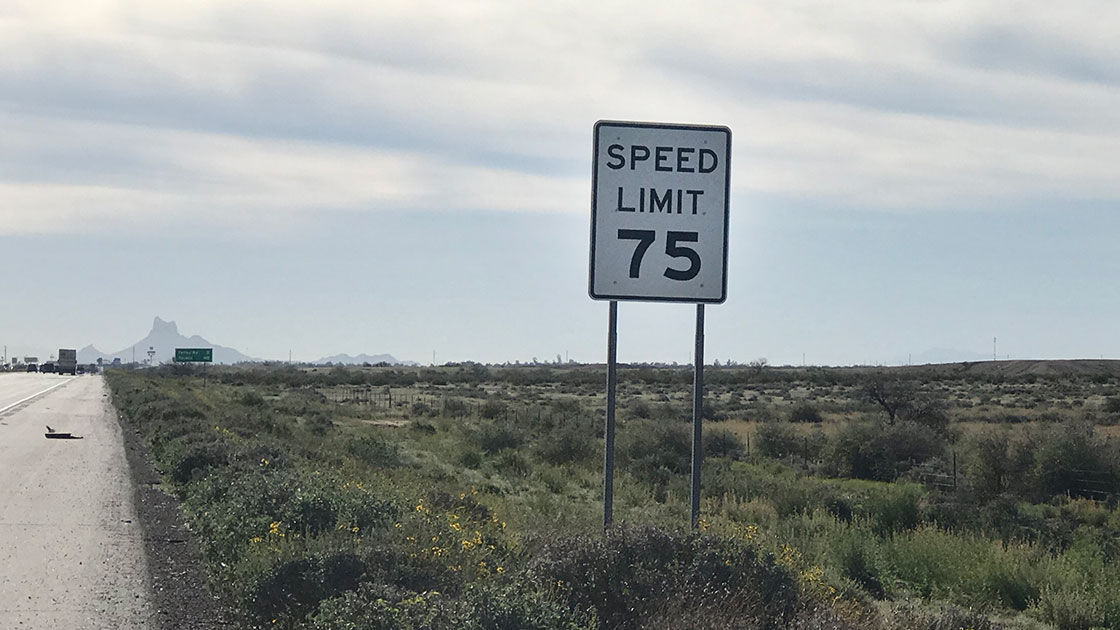
Raising Speed Limits Cost Lives

Are people surprised by this?

It burns gas and is harder on the brakes, etc. All part of the game.

Going faster also doesn't generally save that much time unless it's like 30-40 mph more and even that will be impeded by traffic, lights etc.

I typically pull up next to the moron at the red light who needed to NASCAR around everyone to get their circle jerk fix.
 
My experience living in a state with higher speed limits that isn’t really the case.

Commuting in CO where it was 75 it seemed that almost everybody was 75-80. Some for the road conditions reasons and some due to how it is enforced. In SD where it’s 80 you don’t see people driving too much faster.

In Iowa I pretty much set my cruise at 79 and have never been pulled over on the interstate.

I really think in Iowa on two lane highways there needs to at least tighter enforcement during planting and harvest season. Most people are pretty aware of farm traffic but there are plenty driving way too fast on highways where you might go over a hill and have a combine or tractor. I would even be ok with increases in speed limits outside of those times, but we need to be really cautious during heavy farm traffic periods.

This is the correct answer. The issue isn’t the speed you are traveling, it is the speed delta of the various cars on the road. If everyone were traveling 75 mph, there wouldn’t be an issue. Having some people drive 75 and some drive 60 is what causes the problems. Set the speed higher, but enforce it and these numbers will come down.
 
  • Like
Reactions: CYDJ and robahrens
That only accounts for an increased severity, not number. IMO, more cars and more distracted drivers are far greater causes to the increase in accidents.

Speed may contribute, but that isn't happening in a bubble.
The increased severity is exactly the point.

The article and study is not talking about total accidents.
They’re looking at the death toll from 1993 to 2017 and arguing that it could have and should have been lower if speed limits had not been raised.
 
Should have put a limit on size of farm equipment a long time ago. When you have to pull over on county road because there's not enough room to meet or you have to follow for miles because you can't pass there too big.
 
I'm of the belief that as self driving cars slowly take over, accidents are going to plummet. Adoption will take a long time though.

Disagree. Self driving cars will reduce people’s ability to drive manually. But there are weather conditions that self driving cars will not operate in. So people will always be forced to drive at times. So you may see accidents fall in places like San Diego, but heaven help us when there’s a snowfall in Iowa.

As an example, what percentage of the population can back out of their driveway without a backup camera? Once those became standard, people relied on them and lost the ability to check their mirrors and over their shoulder.
 
This is long overdue.

55 in most of rural Iowa is just too damn slow. If you have to drive a lot, this will literally give you time back. In good weather, I'm always 9 over, and if it's a road I know well and rarely see police traffic, I'll go 70-75 without hesitation.

I work a lot and those minutes shaved off commuting add up quickly. It's more time with my family, less time sitting in a box by myself.
 
Disagree. Self driving cars will reduce people’s ability to drive manually. But there are weather conditions that self driving cars will not operate in. So people will always be forced to drive at times. So you may see accidents fall in places like San Diego, but heaven help us when there’s a snowfall in Iowa.

As an example, what percentage of the population can back out of their driveway without a backup camera? Once those became standard, people relied on them and lost the ability to check their mirrors and over their shoulder.
I think self driving cars will eventually handle snow better than humans.

Even if it doesn't, the % of driving hours that takes place in snow/ice conditions is small. I find it hard to believe that even an increase in accidents under those conditions would not still be significantly offset by the reduced accidents under non-slippery conditions.
 
  • The Argument: If a speed limit is set too low, it creates a wider gap between those who follow the law and those who drive at a speed they feel is natural for the road. This variance leads to more lane changes, tailgating, and "braking waves," which can increase the frequency of accidents.
  • Fact: Proponents of higher limits argue that raising the limit to match actual driving behavior (the 85th percentile) reduces variance and creates a smoother, safer flow of traffic.
 
The increased severity is exactly the point.

The article and study is not talking about total accidents.
They’re looking at the death toll from 1993 to 2017 and arguing that it could have and should have been lower if speed limits had not been raised.
If reducing traffic deaths is the only metric, then yeah, reducing speeds would do that. I think everyone agrees that 0 traffic deaths isn't reasonable, so the question is "what is acceptable", and you'll get 350million different answers.
 
Everytime I visit Iowa I am disgusted with their nanny state mentality. I always know once I have entered Iowa because of the insanely slow speeds one is allowed to travel at.

When I licensed my CanAm Maverick XRC for on-road usage there was no inspection station where I had to take the CanAm to make surexI had the appropriate safety gear installed. When I called the state to find the closest inspection station they told me, "If you get pulled over and you do not have the appropriate safety gear installed it will be your ticket." That was it- all the responsibility resides with the individual not the nanny state.
 
I think self driving cars will eventually handle snow better than humans.

Even if it doesn't, the % of driving hours that takes place in snow/ice conditions is small. I find it hard to believe that even an increase in accidents under those conditions would not still be significantly offset by the reduced accidents under non-slippery conditions.
I tried out Full Self Drive on my wife's tesla this last winter in a snowstorm. It was surprisingly great. It detected slippage, and adjusted accordingly. The only downfall I saw was that in certain weather conditions the cameras would get blocked, and then it would warn you and shut off. It's getting so close. I think I read this morning that FSD has driven 8 billion miles and is 7x less likely to be in an accident. This is really amazing when you think about how it wasn't that good a year ago at this time.

"As noted in data shared by Tesla watcher Sawyer Merritt, annual FSD (Supervised) miles have increased from roughly 6 million in 2021 to 80 million in 2022, 670 million in 2023, 2.25 billion in 2024, and 4.25 billion in 2025. In just the first 50 days of 2026, Tesla owners logged another 1 billion miles."
 
  • Informative
Reactions: Letterkenny
The increased severity is exactly the point.

The article and study is not talking about total accidents.
They’re looking at the death toll from 1993 to 2017 and arguing that it could have and should have been lower if speed limits had not been raised.
More people --> more accidents -->more multi-vehicle accidents --> more severe accidents.

Phone usage is a massive cause of accidents. Following too closely causes tons of accidents (and this is where speed really does come into play, IMO)

Plus, as a casual observer, there are much larger vehicles (trucks/suvs, etc) that likely contribute to the severity of accidents.

I'm just saying it's naive to attribute this solely to speed. Speed is a factor, but if cops cracked down on idiots on phones, that would do more good than anything else.
 
  • The Argument: If a speed limit is set too low, it creates a wider gap between those who follow the law and those who drive at a speed they feel is natural for the road. This variance leads to more lane changes, tailgating, and "braking waves," which can increase the frequency of accidents.
  • Fact: Proponents of higher limits argue that raising the limit to match actual driving behavior (the 85th percentile) reduces variance and creates a smoother, safer flow of traffic.

But, as we’ve seen in Iowa with the increase in speed limits in the interstates, if you increase the limit by 5 mph, those that always go 10 mph over will also increase their speed. Enforcement, regardless of the limit, is the best way to save lives.
 
I tried out Full Self Drive on my wife's tesla this last winter in a snowstorm. It was surprisingly great. It detected slippage, and adjusted accordingly. The only downfall I saw was that in certain weather conditions the cameras would get blocked, and then it would warn you and shut off. It's getting so close. I think I read this morning that FSD has driven 8 billion miles and is 7x less likely to be in an accident. This is really amazing when you think about how it wasn't that good a year ago at this time.

"As noted in data shared by Tesla watcher Sawyer Merritt, annual FSD (Supervised) miles have increased from roughly 6 million in 2021 to 80 million in 2022, 670 million in 2023, 2.25 billion in 2024, and 4.25 billion in 2025. In just the first 50 days of 2026, Tesla owners logged another 1 billion miles."

But, as you noted, cameras get blocked. Which will necessitate drivers having to drive manually. Software cannot overcome physics.
 
  • Like
Reactions: VeloClone
But, as we’ve seen in Iowa with the increase in speed limits in the interstates, if you increase the limit by 5 mph, those that always go 10 mph over will also increase their speed. Enforcement, regardless of the limit, is the best way to save lives.
A 1997 Federal Highway Administration (FHWA) study found that raising or lowering speed limits by as much as 15 mph had very little effect on actual travel speeds. In many cases, raising a limit simply legalized the existing behavior of the majority without significantly increasing the top speeds.

Not sure if there has been a more recent study on this.

Iowa Department of Transportation / Iowa State University Study (2019)​

A study specifically looking at Iowa's transition to higher limits found a "diminishing return" on speed increases.

  • The Findings: They noted that while average speeds increased slightly when the limit went from 65 to 70 mph, the increase began to taper off at the highest limits (75+ mph).
  • The "Speed Variance" Factor: The study reinforced a key part of your 1997 premise: that speed variance (the difference between the fastest and slowest cars) is a bigger predictor of crashes than the absolute speed. They found that raising limits sometimes decreased variance by bringing the "slow" drivers up to the speed of the "fast" majority, which can actually improve safety in some contexts.
 
But, as you noted, cameras get blocked. Which will necessitate drivers having to drive manually. Software cannot overcome physics.
Yes, for .01% of the time. People are not just going to start running into each other for the 3 miles a year they have to drive.

Also, I've noticed that if it's rain that is stopping the cameras from working, you should probably pull over because if the camera can't see, neither can you.