When do you think you will buy a 100% pure electric vehicle?

When will you buy a 100% pure electric vehicle?

  • Already Own One

    Votes: 72 8.1%
  • In the next year

    Votes: 7 0.8%
  • Between 1-5 years

    Votes: 163 18.4%
  • 6-10 years

    Votes: 189 21.4%
  • 10+ years or never

    Votes: 454 51.3%

  • Total voters
    885
100% accurate. I can do everything to my ‘65, but my modern hybrid isn’t designed to make anything easy to work on. Modern brake systems require a computer to unlock them just to change brake pads.
Your talking a 1965 engine. Much different maintenance than more modern ICE vehicles.

Not sure why every post in this thread tends to be a source of argument. If you love EV's awesome. If ICE vehicles meet your personal needs, great for you. The better option, is personal.

At the same time, IMO it's only a matter of 5-10 years before EV's make up 80%+ new vehicle sales in US. And that's being conservative. At some point, it won't be cost effective to buy, maintain, refuel ICE vehicles. And it won't make sense for legacy automakers to build.
 
Your talking a 1965 engine. Much different maintenance than more modern ICE vehicles.

Not sure why every post in this thread tends to be a source of argument. If you love EV's awesome. If ICE vehicles meet your personal needs, great for you. The better option, is personal.

At the same time, IMO it's only a matter of 5-10 years before EV's make up 80%+ new vehicle sales in US. And that's being conservative. At some point, it won't be cost effective to buy, maintain, refuel ICE vehicles. And it won't make sense for legacy automakers to build.
Legacy automakers are pulling back on EVs worldwide. And most places it seems taxes/regulations are more a driver then actual capabilities.
Europe surges, US stumbles, China cools: EV sales dip in 2026 | Electrek https://share.google/5lAZ7uSI7bth0aVxd
 
Legacy automakers are pulling back on EVs worldwide. And most places it seems taxes/regulations are more a driver then actual capabilities.
Europe surges, US stumbles, China cools: EV sales dip in 2026 | Electrek https://share.google/5lAZ7uSI7bth0aVxd
The global EV transition isn’t going to reverse; it will keep growing. It’s just becoming more uneven and more political.
You seem very evangelical about this topic for some reason, based on the username I'm guessing mechanic?
 
  • Haha
Reactions: motorcy90
I’d wager there won’t be ANY ev cars on the road that are 30+ years old. I’m still driving a 65 Mustang with the original engine. One rebuild in it. Know a guy that has a late 60’s Shelby he uses as a daily driver and always has. Mechanical cars will always be easier to maintain over their lifespans.
You need to separate hobbyists from mainstream people because nobody who looks at a car as just a transportation device is driving something from the 60s. Thirty years from now I can guarantee there will be somebody driving around in a pristine original year Cybertruck bragging about how cool it is. For those people replacing the battery, if they need to, won't be any different than you not still using the original gas that was first put in your car.
 
  • Like
Reactions: aobie and RedlineSi
When was the last you ever replaced half of those actual parts? Filters are cheap. I mean a buddy finally replaced a water pump on his truck at 280k miles last year.
And I had a starter go out on a Kia rio at 80,000 miles. You coming in this thread and acting like a *ss daily really doesn't improve the thread or most people's opinion of you.
Hell you like ICE vehicles no one is forcing you to change. They will be available for quite a while, I'm guessing you'll be able to buy one for as long as your alive and able to drive.
But you do you .
 
You need to separate hobbyists from mainstream people because nobody who looks at a car as just a transportation device is driving something from the 60s. Thirty years from now I can guarantee there will be somebody driving around in a pristine original year Cybertruck bragging about how cool it is. For those people replacing the battery, if they need to, won't be any different than you not still using the original gas that was first put in your car.
Well to be honest the Cybertruck will never be cool. Unique but never cool.
 
  • Informative
Reactions: aobie and VeloClone
You need to separate hobbyists from mainstream people because nobody who looks at a car as just a transportation device is driving something from the 60s. Thirty years from now I can guarantee there will be somebody driving around in a pristine original year Cybertruck bragging about how cool it is. For those people replacing the battery, if they need to, won't be any different than you not still using the original gas that was first put in your car.
The glue holding the cybertruck together will fail long before this scenario happens.
 
You’re acting like there are lots of 50+ year old cars that are in everyday use.

No.

Using a quote from your reference shows that it’s the more recent model years that are disappearing at a high rate.

“That’s a 55 percent survival rate, which is quite impressive for a vehicle built 50 years ago. For sobering comparison, consider that IHS/Markit estimates more than a quarter of the model-year 2000 vehicles on the road in 2018 have vanished in the last three years.”

Why? Vehicles built in the last 30 years are built to be disposable. Doesn’t mean diddly about whether gas or electric vehicles are better, but it does say something more about living in a consumer society.
 
Some of my family in California would like a word.
They had a mandate about no new ICE cars after 2030 didn't they? But it didn't effect used cars or cars brought in from other states did it? I remember something but I'm fuzzy on the details.
 
Using a quote from your reference shows that it’s the more recent model years that are disappearing at a high rate.

“That’s a 55 percent survival rate, which is quite impressive for a vehicle built 50 years ago. For sobering comparison, consider that IHS/Markit estimates more than a quarter of the model-year 2000 vehicles on the road in 2018 have vanished in the last three years.”

Why? Vehicles built in the last 30 years are built to be disposable. Doesn’t mean diddly about whether gas or electric vehicles are better, but it does say something more about living in a consumer society.

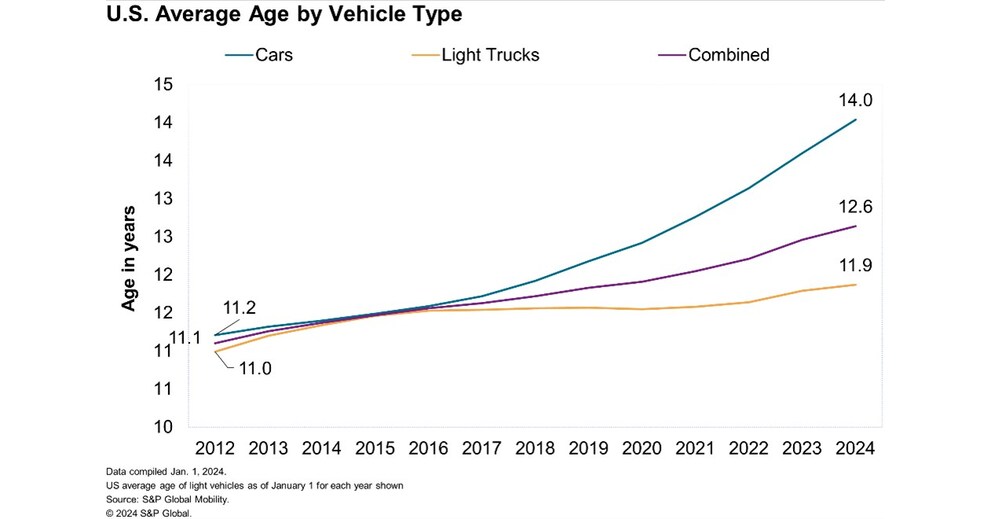
Average lifespan of cars was 8 years in the 70s, it’s 12 years now, and it’s been on a continuous upward trajectory.

 
Legacy automakers are pulling back on EVs worldwide. And most places it seems taxes/regulations are more a driver then actual capabilities.
Europe surges, US stumbles, China cools: EV sales dip in 2026 | Electrek https://share.google/5lAZ7uSI7bth0aVxd
EV vs. ICE market penetration isn't about 2026. It's about where the market will be 2030+.

Also month over month sales or year over year sales drops are a fact of the auto marketplace. They are not indications if longer term trends. It's a highly seasonal & cyclic industry and has been historically.
 
  • Like
Reactions: wxman1
Using a quote from your reference shows that it’s the more recent model years that are disappearing at a high rate.

“That’s a 55 percent survival rate, which is quite impressive for a vehicle built 50 years ago. For sobering comparison, consider that IHS/Markit estimates more than a quarter of the model-year 2000 vehicles on the road in 2018 have vanished in the last three years.”

Why? Vehicles built in the last 30 years are built to be disposable. Doesn’t mean diddly about whether gas or electric vehicles are better, but it does say something more about living in a consumer society.
Most any car can be saved if someone wants to spend the money on it.
 
Average lifespan of cars was 8 years in the 70s, it’s 12 years now, and it’s been on a continuous upward trajectory.

It’s wild to see an age where 100,000 miles was a death sentence held up to recent ages where that’s just getting broken in.
 
  • Winner
Reactions: motorcy90
At the same time, IMO it's only a matter of 5-10 years before EV's make up 80%+ new vehicle sales in US. And that's being conservative. At some point, it won't be cost effective to buy, maintain, refuel ICE vehicles. And it won't make sense for legacy automakers to build.
Unpossible.
1771695622779.png
 
That's true, but transport of electrons to point of service is a lot cheaper and easier. Its also possible to generate electrons for very little cost, and with very little environmental damage. I posted the Economist article about what the Chinese are doing on EVs, batteries, and solar earlier in this thread (I think it was this thread). Check it out, it is an eye-opening article.

And with cars, batteries being heavier than gas is offset (admittedly I don't know by what %) by no transmission etc. And it doesn't matter that much in a car application. Now for aircraft and other things where weight is crucial - yes the tech is probably a ways off.
I'll argue with you on the very little environmental damage unless you are talking nuclear. The costs are also all artificially manipulated.

I think electric cars are great and fun. The torque you get is amazing, but I don't believe they are a mass solution to a problem. Both they and the "green" means of producing electricity cause massive environmental damage through their production and hazardous waste when their life cycle is complete. Whatever you are promised in the future, less than 5% of lithium batteries are currently recycled, and like most touted miraculous cancer treatments, the promises in the future are most often not realized. Solar panels and windmills will also end up in landfills. The truth is none of these things are currently financially competitive without government intervention, and the vast majority are produced in China with ultra cheap or prison labor and zero environmental regulation.

Having a tiny country like Norway or Sweden go electric almost exclusively due to government interference with their mass hydroelectric resources and low population. China is also a different animal with the government directing things, absolute lack of environmental law, and no integrity in reporting. China may be increasing their green grid, but they are increasing their coal fired plants even more.

To me a more balanced approach is better, let the free market do its thing and you'll get the best result.
 
I'll argue with you on the very little environmental damage unless you are talking nuclear. The costs are also all artificially manipulated.

I think electric cars are great and fun. The torque you get is amazing, but I don't believe they are a mass solution to a problem. Both they and the "green" means of producing electricity cause massive environmental damage through their production and hazardous waste when their life cycle is complete. Whatever you are promised in the future, less than 5% of lithium batteries are currently recycled, and like most touted miraculous cancer treatments, the promises in the future are most often not realized. Solar panels and windmills will also end up in landfills. The truth is none of these things are currently financially competitive without government intervention, and the vast majority are produced in China with ultra cheap or prison labor and zero environmental regulation.

Having a tiny country like Norway or Sweden go electric almost exclusively due to government interference with their mass hydroelectric resources and low population. China is also a different animal with the government directing things, absolute lack of environmental law, and no integrity in reporting. China may be increasing their green grid, but they are increasing their coal fired plants even more.

To me a more balanced approach is better, let the free market do its thing and you'll get the best result.
This statistic is thrown around a lot on social media but it is nowhere near the actual number. It's actually closer to 60%.

 
  • Informative
Reactions: aobie and VeloClone