Financial Thread

No, you're right. Running it into the ground is almost always better financially. I just don't have that kind of discipline when it comes to cars. I tell myself things like "I decided to not have kids so I'm going to always have a nice car". What I should be saying is "You're wasting money fool".

I had my last ride 14 years. I estimate that I saved $50,000 by running that bad boy until it died.
 
Simply having debt on a car doesn't (necessarily) mean you have too much car. For many people a $20-25K purchase without taking on any debt isn't practical. What is practical is buying a reasonably priced, reliable car and ensuring that your car loan is for 2-3 years, not 5-6.

I don't look at it that way. I look at it like this:

My wife comes to me and says "The heel of my shoe fell off and I need a replacement". The problem is that we only have $10 saved to buy her new shoes but the ones she wants are $80.

In my world
We'll take the $10 and fix your shoes and start saving for those $80 shoes. I would tell her "next time give me a little heads up so we can save more for the replacement"

In my world I'm always saving for my next vehicles so that I don't have to get a loan. It's just like making loan payments except that I'm not tied into a loan in case something bad happens. Once people pay off their car I don't understand why they don't start saving for the next one. Actually I do understand, a large majority of people never pay off their car and just go from car loan to car loan.
 
Invest in the 401k up to the point at which you earn the full company match. Then open up a Roth IRA (I'll put in a plug for Vanguard here) and max that out. Once you've done that, go back to the 401k.


just to piggyback on this because it wasn't something that I realized - you have complete control of the Roth IRA. You can essentially treat it as extra savings. Because anything you put in (not gains) can be taken out penalty free if you all of a sudden need extra money (though that shouldn't be something you're doing anyway). If it's in a 401k, even a Roth 401k, there may be some more hoops to jump through. Plus you will likely have more options to invest in through your own IRA vs. a company's options.
 
just to piggyback on this because it wasn't something that I realized - you have complete control of the Roth IRA. You can essentially treat it as extra savings. Because anything you put in (not gains) can be taken out penalty free if you all of a sudden need extra money (though that shouldn't be something you're doing anyway). If it's in a 401k, even a Roth 401k, there may be some more hoops to jump through. Plus you will likely have more options to invest in through your own IRA vs. a company's options.

This big time. Most 401k's are filled with high cost funds that you don't need.
 
Invest in the 401k up to the point at which you earn the full company match. Then open up a Roth IRA (I'll put in a plug for Vanguard here) and max that out. Once you've done that, go back to the 401k.
Good advice so you'll be happy to hear I'm already doing that.
 
This big time. Most 401k's are filled with high cost funds that you don't need.


yeah mine are nearly all over .5 and probably 40-50% well over 1. Both of DH's companies have been nearly all Vanguard options. I tried to ask about getting some better options (only had one S&P index fund option - that was actually on a lot of top ten lists - and they just swapped it out for one .2 higher in fees......single international option is like 1.5%.....etc.) and was pretty much given a "don't worry your pretty little head, little girl" type of response.
 
I agree completely. The key to debt is knowing you have an income stream to pay it off with. But if you're disciplined, debt can be a tool.

And as for cars, the debt absolutists will tell you never to take on debt, even for a car. Well I'm an excellent saver and I'm years away from being able to pay cash for a respectable car.

Good financial management is all about knowing what your weaknesses are and building habits or structures that minimize them.

It depends on what you call respectable. If by respectable you mean a car in the $20K range then yes that's very tough. On the other hand, if you mean a car in the $5-10K range then not as much. I would consider a car $20K and above a nice car, and in the $10K range to be respectable. I bought my car in 2009 (2003 Honda Accord) for about $7500 and it is in good shape, gets good gas mileage, and runs reliably. Sure, it's not fancy but it's not ugly either. I guess I'm also lucky in that I'm not a car person, so it doesn't bother me that I drive a 4 cylinder lame car. The way I figure is that I'll work my way up and each car "cycle" I'll be able to afford a nicer one.
 
just to piggyback on this because it wasn't something that I realized - you have complete control of the Roth IRA. You can essentially treat it as extra savings. Because anything you put in (not gains) can be taken out penalty free if you all of a sudden need extra money (though that shouldn't be something you're doing anyway). If it's in a 401k, even a Roth 401k, there may be some more hoops to jump through. Plus you will likely have more options to invest in through your own IRA vs. a company's options.

Absolutely. And when you switch jobs, don't roll your funds into your new employer's plan. Roll them over to an IRA with the vendor of your choice. (Whatever you do, don't cash it out!) Then you'll always have complete control over it.
 
Any have a recommended Financial Planner or Advisor in the Ankeny or Urbandale area that they would recommend?

What are they fee structures like for such services?

Any information is appreciated.
 
One thing that kind of puts me off about Mint, is what happens if they ever get hacked? They say they are a read-only service, which is great. but if they were hacked, the hackers would have access to not only your bank account numbers, but the passwords to go with them. Then they could just go over to the mobile banking side and have access. Am I wrong in thinking this?

This is really the only thing holding me back from signing up for it at this point..
 
I am not a debt absolutist, but debt on a car is just not smart and means you are buying too much car. Car purchases are the financial crux of the middle class. You want as low a % of your world tied up in cars as possible. Right now, the value of my wife and my cars (no kids) are 8% of our annual income.

I have friends that bought $35,000 trucks and make about $35,000 then wonder how we could afford to buy a home when they can't. They have a whole year's salary going backwards in value, on loan, while I drive "junky" cars that equal 8% of my salary going backwards in value.

My car is 5% of my current salary, but the great part is I got it at 60% of it's value 5 years ago so it is worth the same now as what I paid for it then. I'll probably have it another 5 years, never been a car person just get me there.
 
I have no money. That makes it easy to not spend.

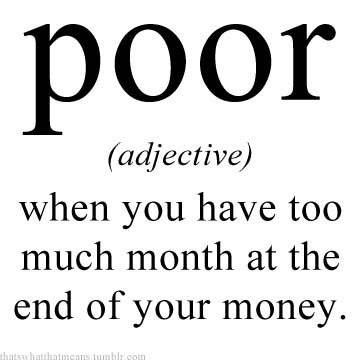
poor-is-when-you-have-too-much-month-at-the-end-of-your-money.jpg


Been there, many times. Get close still sometimes. It will get better.
 
One thing that kind of puts me off about Mint, is what happens if they ever get hacked? They say they are a read-only service, which is great. but if they were hacked, the hackers would have access to not only your bank account numbers, but the passwords to go with them. Then they could just go over to the mobile banking side and have access. Am I wrong in thinking this?

This is really the only thing holding me back from signing up for it at this point..


I haven't had a problem in three years of using it - this was something my husband asked about too. I did some reading and they say they use the same level of security as banking systems. Any type of breach and the entire Mint system would be toast.

http://bucks.blogs.nytimes.com/2010/07/06/should-you-trust-mint-com/
 
Personally, while I don't think debt is evil exactly I think it is a major cause for problems our society faces. People are told the same thing you are saying, debt is ok if it's low interest and you can use it to afford nice things. That may be true, but it is also neglecting two important factors: risk and liquidity. The more debts you have, the more trouble you will be in if you ever lose your job. The more monthly payments you have, the less net income you make each month so you can't afford to do anything because all your money goes toward your payments. Then, you feel like you have to take out even more debt since you have so little coming in on a monthly basis you can't save up.

People get themselves into debt up to their eyeballs and they rationalize by saying it's 0% interest or it's low interest, or this is a good investment. Then, they feel much poorer than they really are because they can't afford anything beyond their monthly debt payments. It's the way society would have us believe we need to live, every message in every advertisement says to go ahead and take out loans. I'm not saying you personally do this, but there are millions of Americans who do and it's really sad to me. I don't think anyone should ever be told to take out debt without a very strong need. Debt should be a last resort during tough times or a calculated business move, not a way to afford consumer goods.


Which is why I said you need to be smart about it. Loading up on debt is definitely not recommended but people saying you can't go out and buy a car at 0% unless you can pay 100% cash isn't necessarily accurate either.

I could go out and buy my next car with cash but doing so would take away my ability to continue to invest in real estate at the level I want to. So leveraging debt for me is huge and brings me more income long term. So saying "don't take out any debt outside of a mortgage" can be just as foolish as well.
 
Last edited:
One thing that kind of puts me off about Mint, is what happens if they ever get hacked? They say they are a read-only service, which is great. but if they were hacked, the hackers would have access to not only your bank account numbers, but the passwords to go with them. Then they could just go over to the mobile banking side and have access. Am I wrong in thinking this?

This is really the only thing holding me back from signing up for it at this point..

I never have much in the bank account anyway, and wouldn't all but $50 of any bank account or credit card be covered by the company or the FDIC?
 
What would you guys think of changing my 401k contribution every few months or so to a high percentage and then lowering it back to normal? I'm able to change mine whenever I want which may be typical, I'm not sure. The max is 99%, but obviously I don't see myself doing that.
 

Latest posts

Help Support Us

Become a patron